 SaaS Partner Co.
Practical guidance for building, launching, and growing Shopify apps.


Most Shopify apps compete for merchants willing to pay $10, $20, or $49 per month. But some charge $500, $1,000, or even close to $3,000 per month. And merchants are willing to pay.
How is that possible? Are these apps simply more complicated, do they offer hundreds of features, or are they solving problems valuable enough to justify a much higher price? A look at some of the most expensive publicly priced Shopify apps reveals that many are selling more than software: they provide business infrastructure, expertise, automation, and measurable value.
High pricing is not necessarily about having more features. It is about delivering more business value.
Examples of highest publicly listed monthly plans include Venn Apps at $2,999, Tapcart at $2,850, Appmaker and Fydez at $2,000, and StoreLab at $1,999. Prices and plan availability can change.
Venn Apps - $2,999 per month. Venn Apps provides mobile app solutions for Shopify merchants, with its Enterprise plan reaching $2,999 per month. Merchants are not simply paying for access to a mobile app builder: the offering includes premium integrations, custom design, multilingual capabilities, loyalty features, and dedicated account management. The company is selling a complete mobile commerce solution. Shopify App Store listing: https://apps.shopify.com/venn-apps.
Tapcart - $2,850 per month. Tapcart helps Shopify merchants build native iOS and Android shopping applications. Its Enterprise+ offering reaches $2,850 per month and provides more than a basic mobile app builder. Enterprise customers get advanced developer tools, custom infrastructure, dedicated account management, and capabilities designed for larger businesses. For an established ecommerce brand, a dedicated mobile shopping experience can be an important sales and retention channel. Shopify App Store listing: https://apps.shopify.com/shopify-mobile-apps.
Appmaker - $2,000 per month. Appmaker is another mobile commerce platform with premium pricing. Its highest identified public plan reaches $2,000 per month. Its business model combines recurring subscription revenue with an additional 1% fee on sales generated through the mobile app, creating predictable subscription revenue and additional revenue as the merchant sells more. This connects pricing to the value the product helps generate. Shopify App Store listing: https://apps.shopify.com/appmaker.
Fydez - $2,000 per month. Fydez offers mobile app and omnichannel solutions for Shopify merchants, with its Hybrid Retail plan reaching $2,000 per month. The platform combines mobile commerce with integrations and features such as loyalty, referrals, reviews, and retail functionality. Instead of solving one small problem, Fydez positions itself as part of a merchant's broader commerce infrastructure.
StoreLab - $1,999 per month. StoreLab's Professional plan reaches $1,999 per month. Alongside mobile app technology, the offering includes app management, design, marketing support, strategy, and ongoing assistance. This combines software with professional services: merchants pay for both a solution and the expertise required to make it work.
High pricing is not necessarily about having more features. It is about delivering more business value.
Revenue generation. If an application helps a merchant generate an additional $20,000 in monthly revenue, paying $1,000 or $2,000 for it may be a reasonable business decision. An app might improve conversion rates, increase average order value, or generate more repeat purchases. Merchants compare the subscription cost with the financial impact of using the product. Instead of asking how many features an app can include, ask how much money can it help merchants make or save? Products connected to measurable financial results can be easier to price at a premium.
Solving expensive problems. A small design improvement might be worth $10 per month, while automating work that takes several employees, managing thousands of orders, or integrating multiple business systems can be worth considerably more. Examples include complex inventory workflows, subscriptions across sales channels, enterprise data synchronization, large-scale marketing operations, and customer support across multiple channels. Merchants may pay more when an application addresses an expensive problem.
Custom integrations and infrastructure. Smaller Shopify apps often focus on standard integrations and predefined workflows. Enterprise applications may need custom API integrations, multiple storefronts, advanced permissions, custom workflows, large data volumes, dedicated infrastructure, and enterprise security. Supporting these requirements costs money and can make the application harder to replace. When deeply integrated into a merchant's operations, its value extends beyond its individual features.
Dedicated support and account management. A $19-per-month app usually cannot provide every merchant with a dedicated account manager, but a $2,000-per-month application can. Premium customers may receive personal onboarding, dedicated account management, priority support, custom implementation, strategic consultations, and regular performance reviews. For larger merchants, a person helping them get results can be as important as the software.
Managed services instead of pure SaaS. Some companies combine software with ongoing professional services. StoreLab, for example, offers management, strategy, and marketing-related support rather than giving merchants a dashboard and expecting them to figure everything out. This changes the economics: a pure SaaS product needs to automate as much as possible, while a software-plus-services business can charge more by providing human expertise. The product becomes part of an ongoing business partnership rather than just another installed app.
Pure SaaS typically offers self-service onboarding, standard features, automated support, lower operating costs, and greater scalability, which often supports lower pricing. Software plus services can include personal onboarding, custom solutions, dedicated support, and more resources per client, which can support premium pricing. Neither model is automatically better: choose the model that fits the problem and merchants you target. Even a small amount of extra service, such as better onboarding, implementation help, or a monthly strategy call, can make an offer more valuable without turning the business into an agency.
These examples generate approximately $10,000 in monthly recurring revenue: at $10 per month, 1,000 merchants generate $10,000; at $49, 205 merchants generate $10,045; at $99, 102 merchants generate $10,098; at $499, 21 merchants generate $10,479; at $999, 11 merchants generate $10,989; and at $1,999, 6 merchants generate $11,994.
Acquiring six enterprise customers is not necessarily easier than acquiring 1,000 smaller merchants. Premium customers have higher expectations and may require longer sales cycles, custom integrations, onboarding, and more support. Still, there is more than one way to build a successful Shopify app business: serve thousands of merchants with a simple product, or solve expensive problems for a much smaller group. Both approaches can work if you understand the market and choose a suitable business model.
You do not need to build another Tapcart to apply these principles. Smaller developers also have opportunities to use them.
If your app solves exactly the same problem as ten competitors, lowering the price may seem like the easiest way to attract merchants, but competing only on price can become a race to the bottom. Look for a specific problem existing applications do not solve particularly well. A specialized product can often justify a higher price.
Adding 20 features does not automatically make an app more valuable. One feature that saves a merchant 10 hours every month may be worth more than a collection of small improvements. Consider the financial and operational impact of your product.
You do not have to target every Shopify merchant. An app designed for large Shopify Plus merchants may use a very different pricing strategy from one designed for small businesses. A product built for subscription-based businesses may also justify higher pricing if it solves problems general-purpose apps do not address.
Services can create additional revenue without requiring an entirely new product. Consider premium onboarding, custom integrations, data migration, advanced configuration, personal consultations, and priority technical support.
Valuable apps often become deeply integrated into business operations. When merchants depend on an app for critical workflows, replacing it becomes more complicated. This does not mean making cancellation difficult; it means consistently delivering value and becoming an important part of how a business operates. Long-term retention is a strong foundation for a SaaS business.
A Shopify app charging $2,000 per month is not necessarily more successful than one charging $29. A high subscription price tells us something about positioning and target market, but not how many merchants are paying. App Store reviews can help show customer satisfaction and market presence, but review counts are not reliable revenue indicators.
Revenue also depends on customer acquisition costs, retention, churn, support and operating costs, sales cycle length, and the actual number of paying merchants. A $2,000-per-month app with five customers generates $10,000 MRR. A $29-per-month app with 1,000 customers generates $29,000 MRR. Pricing is only one part of the business model; the real question is whether a company can acquire and retain enough customers profitably.
The Shopify ecosystem has a market for simple, affordable apps and for specialized software that solves expensive business problems. Independent developers can find meaningful opportunities by identifying problems with significant business impact, focusing on a specific merchant segment, building products that deliver measurable value, considering premium support and implementation, and pricing according to value rather than feature count.
You do not always need thousands of merchants to build a successful SaaS business. Sometimes, finding 20 businesses with a problem worth solving is a better starting point than trying to convince 2,000 merchants to pay $10 per month. The best pricing strategy is not necessarily the cheapest one; it is the one that reflects the value your application creates.
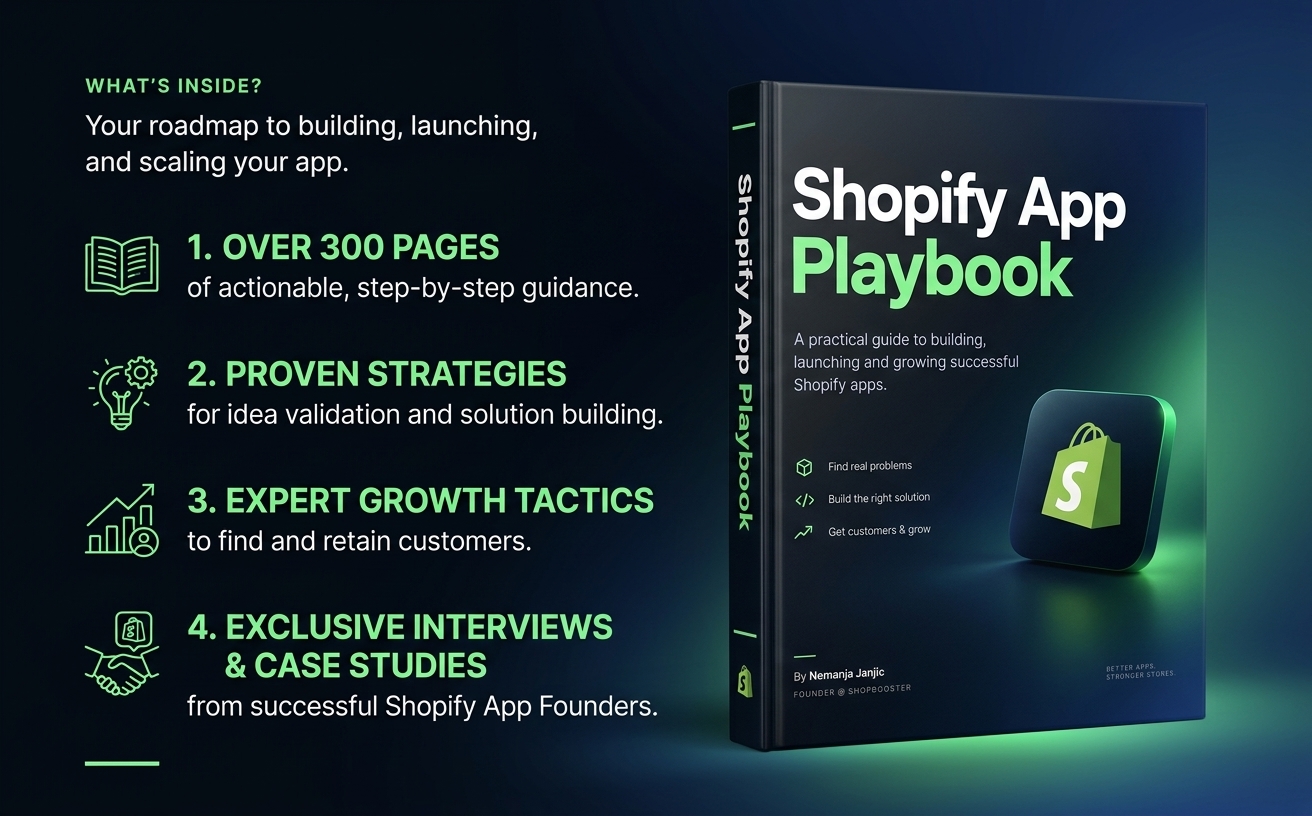
Need a practical framework for your Shopify app? Use this free guide to validate ideas, launch faster, and improve growth decisions.
View Resource GuidePractical guidance for building, launching, and growing Shopify apps.
© 2026 SaaS Partner Co. All rights reserved.